Author Note to the Reader for This Memoir

December 26, 2024

Trigger alert:

This blog shares excerpts of my draft memoir — working title: “I Thrive.” While not graphic, it will discuss aspects of the sexual, physical, and emotional abuse I endured and my journey back to healing…and thriving. These entries start in June, 2025 and continue into the present. Prior entries cover other topics
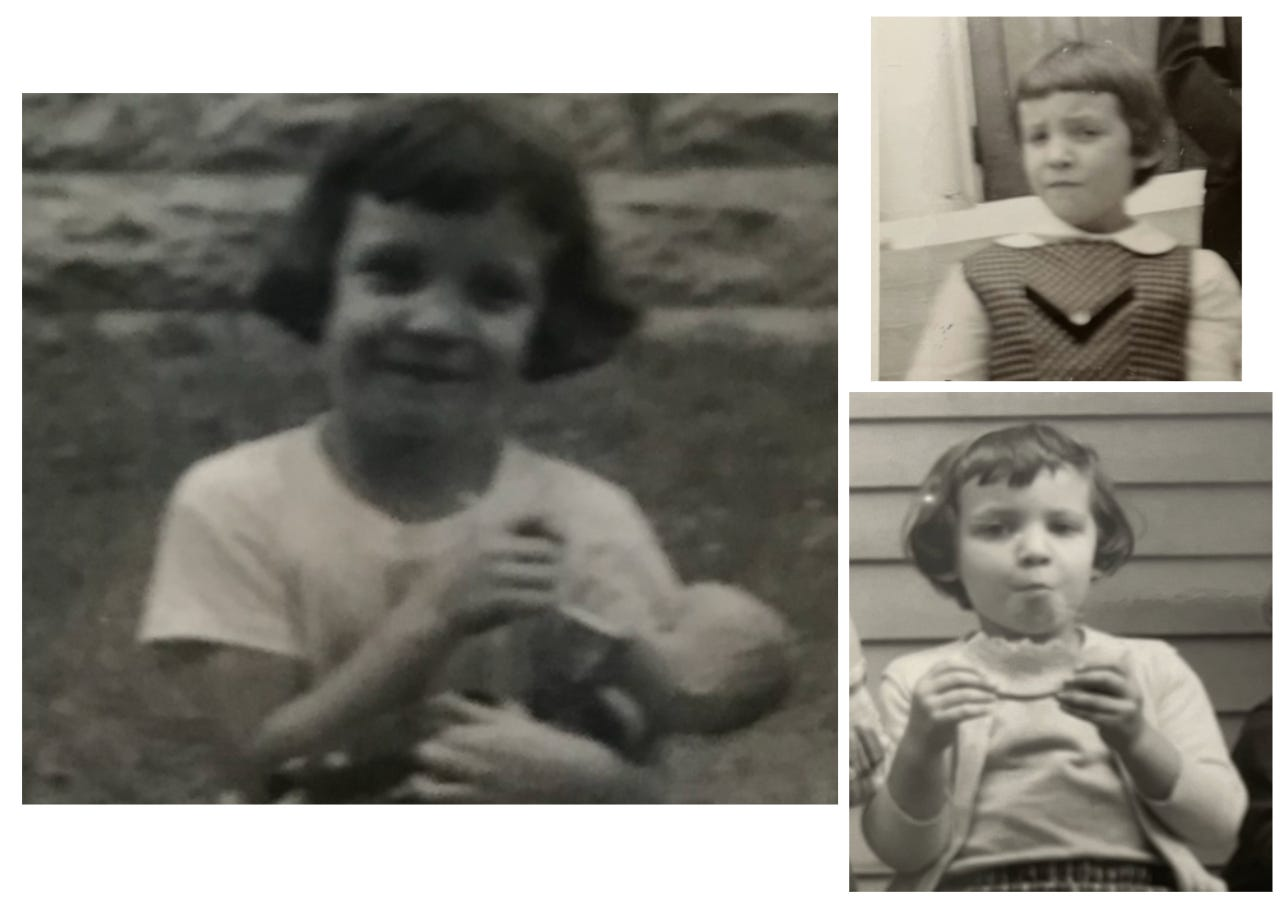
Photo by author, circa 1959-1960

To be the illustration

Memoir expert and author Marion Roach Smith described the genre of memoir this way:

“Memoir is not about you. It’s about something and you are its illustration.”

Another author, Trish Lockard, added that this genre is not just a recounting of things that happened to you because, after all — “Stuff happens to everybody.” Instead, memoir captures one’s reflections about an event when enough time has passed for a change, a transformation, to take place. Those insights gained over time through effort are the gift to the reader—the takeaway.

To only write a list of everything done to you in life without the reflections is like dumping a pile of ingredients on the counter and calling it a cake. It is only a cake when that pile of ingredients has gone through the crucible of a hot oven and been transformed into the real takeaway — dessert. Only then does it have “purpose and meaning.”

I loved how one author, whose name I cannot find, summed it up:

“Don’t just confess. Digest.”

Digestion is change and makes something useful…nutritious. It gives back. And digestion is the unfinished business of my life.

After seven decades of silence, it is time for me to look back, digest the raw material of my life, and obtain the nutrition— the insights that give it meaning. It is not: “Look at what was done to me” so much as the answers to the questions: “Because of what was done, what am I doing with it? What does it mean?” So, my life will be the illustration of that “something” that might have meaning and nutrition for all.
28 years of abuse…and building a “beautiful mosaic”

Read the rest of this entry »

Tools – Writing – The Power of a Single Word

June 20, 2026

The unexpected twist of fate

I love words. Discovering new ones. Sounding them out. Finding out where they originally came from. How their meaning evolved over time.

As a kid, I used to spend summer afternoons reading both the dictionary and Roget’s Thesaurus. Yes, truly. I read them…of my own choice. Another one of my Moments of Respite.

It was just fascinating to find so many meanings for one word, and so many words for one meaning. Then there were all the different ways you could alter words — nouns, adjectives, verbs. And best of all, deciphering the code of odd characters for accents, hyphenations, and pronunciations.

As an unexpected twist of fate, that activity served me well later on, as, at one point in my writing career, I was a freelance lexicographer: I helped write and edit a dictionary and a thesaurus. I made sure every possible nuance of meaning, cultural reference, and usage was there for each word, and that every detail of origin and pronunciation was correct. I couldn’t believe I was being paid to “meet words and learn their life stories!”

So it is no surprise that for this memoir, I have a list of “power words.” They are words that prompt deep reflection on my life, Words that evoke strong emotions. Words that best describe the images in my head, and the depths of my spirituality. And they provide abundant “prompts” for my journaling and this book.

And that is just in English.

Behold!

I also have books now on Hebrew words. Their pronunciations and how to write them in both Hebrew and English fonts. Their root origins, the multiple ways they can be interpreted, and… most importantly… how they connect with my soul’s power in using them. When I write them and form the curves and lines with the pen, I FEEL their power. Especially this one:

Read the rest of this entry »

Tools – Writing, Finally… From the “Outside, In”

June 19, 2026

Finally, it is time to get to the point: Writing and the why, how, what, truth, and courage choices of it all.

I’ll start from the “outer edges” of the subject and move to the “heart of the matter.”

The necessary evil that can be a superpower

In my next post, I am going to talk about the ultimate power in writing – that choice of a single, lonely word a writer makes in a given moment to carry the weight of a life.

The choice of a word can mean the difference between sending a flaming spear of meaning directly into your reader’s heart or missing by a mile and watching the spear land in a puddle and dissolve into soggy smoke.

But before I get down to that core decision, I am going to talk about one “auxiliary” power to keep in mind after you choose your words. Grammar.

Please don’t roll your eyes. And before I get started, I am not a grammar expert. Nor do I want to be. For sure, I am not trying to sound literary or impressive. In fact, call this post my “Grammatical disclaimer.”

Read the rest of this entry »

Tools – Stories – Abused or Abuser – The Examples of Others

June 18, 2026

You may encounter many defeats, but you must not be defeated.
Maya Angelou

How much longer???

First, I saw the photo… then her face. No, actually, it was her eyes peering out of that face that I noticed first of all. They had a haunted quality.

They were gentle. Soft. Wounded. There was a sadness to her face I immediately recognized and ached for. Then I saw the headline and felt not only the ache but also the outrage on her behalf.

It was a BBC article from 27 March 2024: “Long wait for therapy after step-grandfather’s abuse.”

Starting at age five, her step-grandfather sexually, emotionally, and physically abused her. As she got older, it really ramped up, and she noted that along with the constant sexual abuse, there was a lot of physical abuse.

I immediately identified with those elements of her story, even as some aspects of our paths differed. Where I didn’t get out of my house until 28, she left home at 16. However, that didn’t make it better. Just different.

On the plus side, she was able to start telling others what happened and even reported her abuser to the police in 2016. The following year, he was sentenced to 25 years in prison.

However, her own recovery was hampered by the very limited availability of therapy services. As she noted in the article, help availability depended on where you lived. And even when she could get any kind of help, it was short-lived and inadequate.

In that regard, my experience was different. Even though I started late on my journey to healing, I had been able to find and access therapists as I needed and wanted.

To bring awareness to the lack of needed therapy resources in her area in the UK, that girl, Charlotte Robinson, 26 at the time of that article, waived her right to anonymity. She told the world about her struggles with nightmares, flushing, and constant flashbacks, and the need for medication to sleep.

She shared that in seeking help, she’d been on waiting lists for 18-months in the past, and at the time of the article, she had been waiting 3 years for the specialized trauma therapy she needs.

It is stories like hers that infuriate me and bring out the warrior in me. I’ve always been the sort of person who, even when I wouldn’t fight for myself, was ready to fight for or defend another.

These days, though, I no longer have the kind of energy to wage big battles. But given her story, and no doubt ones very, very similar, THAT is a driving force for my writing.

If I can get a strong enough message out there through my story, maybe it can help anyone who is still waiting?

I keep Charlotte Robinson’s picture above my work area, so I don’t forget her eyes. I only hope she is no longer on a waiting list…

The “people”

I cringe a bit using the word “Tools” when speaking of the lives of others. I don’t mean people as “objects.” It is the power of their stories, I guess, the wisdom I get from them…because those stories motivate and teach me.

When I am weary of writing my story, I read about others who have been abused or treated badly in life, and then I go on. I see so many people who’ve overcome such odds or waged such battles to try that I can’t help but be inspired. So, I guess it is the “stories” that are the tools.

Read the rest of this entry »

Tools – Healing for the Body…If My Soul Will Stop Resisting It

June 16, 2026

“Your body is the place where heaven and earth meet.”
God in Your Body: Kabbalah, Mindfulness and Embodied Spiritual Practice, Jay Michaelson

For most of my life, my body was not a meeting place with the Universe but a despised battleground. I hated it. It had betrayed me by yielding to pleasure when he abused me. Failed me by fearing him and freezing up.

It had been his tool for his own gratification, so I loathed what he craved. And he had drilled into us that taking time for self-care was a waste of time. Whenever I got sick, right after I threw up, he would tell me to eat so I could hurry up and get better. Bottom line – the body was something to suck dry and make demands on, not take care of.

So for years I just worked it to death, gave it no quarter, and took from it. It didn’t deserve any better in my estimation. I refused to exercise or give it proper ease and care. I demanded that it deliver, be strong, and be there whenever I placed a demand on it. And I showed it no compassion or gentleness.

News flash: In case it isn’t obvious, that attitude has not served me well. I don’t recommend it.

Second news flash: True healing is not just emotional work. It’s body healing, too.

Because so much of the trauma is stored in the body tissues and nervous system, somatic, or body healing, is essential. Psychiatrist Dr. Bessel van der Kolk, who wrote the book The Body Keeps the Score, describes trauma and its connection to our bodies:

Read the rest of this entry »

Tools – Art – Staying Alive…and Beyond

June 14, 2026

Painting “me”

Recently, I pulled this painted-up black piece of cardboard off my easel so I could place a new, clean one there. I use these backboards to catch excess paint when I am painting around the sides and bottom of the canvases. It keeps paint from getting all over the place.

As I pulled the board off the easel, my husband stopped me from throwing it away.

I know he has always honored my painting efforts and loves what I paint. And he says he loves watching me paint because when I am engaged in my art, I am in a totally different place emotionally.

So I appreciated his support of my work. But I had to ask him, “Why do you want this backboard?”

He was quiet for a moment, then said, “Of anything you’ve created, THIS one is most ‘you.’ It bears the paint of every single piece of artwork you’ve done, either for the book or to relax with. And so I want it. I don’t care about any of the other paintings. This one I am going to frame and keep.”

You never know how a piece of “art” will touch the soul of another.

To be the pipe

The same is true of this book. As much as I needed to do it to help me, I felt like this book was also the answer to my lifelong question: “Because of what happened, what do I do with it?” It was about something much bigger than just me.

I want to help others who may be in pain. I view this whole writing effort not only as a healing work for me, but as something the Universe was asking me to do for whoever out there needed it.

I like to think of it as if I am the “water pipe.” People need water to live. Without it, they won’t make it. But how do you get water from a lake to their homes? Pipes. Now, the pipe is important, yes, but only in the sense that the pipe makes it possible for the people to get what they need. If all they have is an empty pipe, that’s useless. Ultimately, it is the water that is key to their survival.

Read the rest of this entry »

Tools – Art – How to Do the Painting? My Gut Decides…Quickly

June 13, 2026

When memories and emotions finally decide to burst out from behind their walls of decades-long repression and silence, they aren’t timid or quiet. They scream. Rage and sorrow, heartbreak and despair, loss and trauma are not meek.

Faced with a flood of emotions and hundreds of memories all wanting to be captured on canvas at once, I didn’t try to stop them or direct them. I just got out of their way and listened. At that point, it was not a question of “if,” but “how” to give them their say. And even on that count, they drove the bus and dictated the style choices.

I could pretend that I sat down to purposely and strategically plan the “conceptual, aesthetic, and material choices” of the artistic approach for this book… but that would be a lie. I am the servant of those memories and emotions, and so I follow their directives for how to execute the art.

The decisions for how to do that were made quickly, intuitively, and from within. So let’s consider this post, the “Artist Statement,” for the true drivers of the work: Memory and Emotion.

Read the rest of this entry »

Tools – Art – Why SEE it? The Heartfelt Attempt to Reach for Human Connection & Understanding

June 11, 2026

Why show abuse and trauma in art? Why show it to another? Why SEE it?

The very direct version? For the world…and for me and anyone else who was abused.

Let me start with “for the world.”

For the world – the moments NOT in the family photo album

There is a raw reality that exists behind words like abused or molested. Those words are relatively “clean.” Cerebral. They tell another that “this” happened, but they do not convey the real horror of what “this” was.

They do not describe what I had to live through in each of those moments, for thousands of moments. They do not show the true images of what happened behind closed doors. Images that weren’t memorialized in the family photo albums. Those words don’t tell the “other side” of the story.

So, seeing those moments of horror in living color on a canvas gives that story a level of reality that words just can’t match.

My husband, who has watched me paint for every one of these pieces and saw the episodes of abuse emerge in paint, said as much. “I always knew about these things from what you told me, and I believed you. But seeing those moments makes them real in a whole different way. If he were standing here before me right now, I don’t know that I could actually restrain myself from going at him.”

The paintings show things that maybe society has never thought about in relation to “abuse,” things it doesn’t understand, or things it doesn’t want to look at.

And I want society to understand, because that is the only way this can change, and those harmed can be fully loved.

I want society to see what “childhood sexual abuse” really means. For me. For that young child that I was. For anyone out there who has been through it and isn’t understood by anyone around them. And to answer all of those who demand to know, “When are you going to get over this and leave it behind? Why can’t you just forget it already and move on?”

Intention

People may question the motives of artists and writers who are candid and open in sharing these experiences.

I will state totally emphatically that the intention for the art in this book is NOT to shock, traumatize, or titillate.

It is actually a heartfelt attempt to reach for that deepest human need – connection – by communicating what that reality was.

Read the rest of this entry »

Tools – Art…When You’re Just a Raw Nerve

June 10, 2026

Disciplined, driven, unrelenting

I’ve been reading a book by Jim Collins called What to Make of a Life. Over ten years, he and his team researched hundreds of people to see how they managed the challenges and moments of truth in life by harnessing what he calls “their encodings.” Those are people’s special innate talents held within and waiting for us to discover them. When used in the right moments and circumstances, those encodings propel us to fulfill our destinies and lead rich, satisfying lives.

He writes the book using the stories of matched pairs of individuals from all walks of life. For each particular life path, he showed how each member of the pair got started, found their way professionally and personally, then confronted a “cliff” — a moment of big change. Using their unique encodings, he showed how even very similar people can navigate transitions in very different ways.

It’s a great book and one I find very uplifting. It is heartening to read how even the likes of John Glenn, Carlos Santana, Admiral Grace Hopper, or Led Zeppelin’s Robert Plant can struggle, be enmeshed in a fog of “what next,” even choose poorly, then dig deep within to find their way.

I just finished reading the chapter about writers Toni Morrison and Barbara Tuchman. Morrison, winner of a Pulitzer Prize for fiction and the Nobel Prize in literature, wrote stories about the young black girls that did not seem to exist in any books she had read. So she wrote for herself, to create the stories she wanted to read. Barbara Tuchman was passionate about history and making non-fiction as rich a read as any good novel. Very different women, very different writing. But they were similar in one way.

Both were absolutely passionate about writing. They could not “NOT write. “As Morrison put it, “If all the publishers had disappeared in one night, I would have written anyway.”

And both used the word “compulsion” to describe what drove them to write. It wasn’t self-discipline enforced from outside themselves, but an inner compulsion to keep going for the sheer love and desire to see how their next sentence, paragraph, and story would turn out.

I resonated with these two women because that is exactly the word I would use to describe my attitude toward writing this book — compulsion. I MUST write it. I WANT to write it. I NEED to write it, to follow the story’s lead, to learn what wisdom it will reveal along the way. And I NEED to share it with whoever is supposed to find my story.

So I get up, write, research, and plan every day. And every day I channel a driven energy from somewhere within me. And that energy is always there.

Until lately.

Read the rest of this entry »

Tools – Why “Art” Before Words

June 6, 2026

The arts

This is a big topic, a KEY topic for me in my healing journey, bigger, even, than “why write.” In fact, without art, I would never have made the progress I have, and these posts would not exist.

So I am going to spend a couple of posts on art in healing, because there are several important parts to this.

In the fall of 2025, NPR’s Tonya Mosley interviewed Jane Fonda on her Fresh Air segment. In the course of their conversation about healing, the power of the arts came up:

“Jane, there’s a part of that speech, that SAG speech about the arts. And you say specifically that the arts have the power to create empathy, to understand a human so profoundly that you can touch another person’s soul.”

Tonya Mosley, NPR’s Fresh Air, September 2, 2025 – “‘We have to speak, we have to shout’: Jane Fonda is still an activist at 87.”

Touch another person’s soul…Oh my God, yes. I can honestly say that it is through the creations of various artists and actors — Madonna, Barbra Streisand, Meryl Streep, Viola Davis, and others — that I found comfort and wisdom, and received examples of powerful mothering and the “divine feminine” that I never received at home.

Of course, they don’t know this. But it was their masterful performances in their respective arts, delivered with all their hearts to the best of their abilities, that fed my soul when I needed it, and healed wounds like water on a drying, dying plant.

Madonna spoke in an interview of not being “the owner of her talent” but its master. It was given to her to allow it to move through and beyond her to those who need it. And she referred to her creative work in life as “medicine.”

Even scientists mirror these sentiments about the power of art to connect us all, and thus heal our lives:

“Here, around the fire, creative human expressions developed as an important layer of meaning-making and belonging… the activities we now call “the arts” began to take shape as an evolutionary priority to keep us alive. Art-making laid the basic foundation for culture and community among our earliest ancestors…these early gatherings helped to seed the social value of community. Researchers now know that participating in and fostering social connections in this way is akin to exercise for the brain: It improves cognitive function, lowers stress, and diminishes depression. …it allowed our species to build empathy and understanding with others.”
Susan Magsamen and Ivy Ross, Your Brain on Art: How the Arts Transform Us (203)

I could go on with examples, but frankly, I will speak to it myself.

Read the rest of this entry »

The Treasure of Recurring Clues

June 5, 2026

Those recurring moments in time

The next step I need to make sense of my life is to look for things that “repeat” — objects, metaphors, themes, events. It’s one of the reasons I mind map and journal so much.

When I spread out items on a large sheet of paper and stand back, that’s when I start to notice that certain elements come up again and again. And I spot connections between them.

With regards to my journals, I write in Word docs so I can read my writing better. I keep them in binders by date, and for each entry, I put a sticky note at the top of the page that has a few key words as to the topic.

The other plus to storing my notes in Word is that I can then do a global search of the words on that list to see how many documents they show up in. That lets me see if there are changes in that issue over time, whether it’s progress, a relapse, or some new way they come out in my life.

Photo by author

Periodically, I will flip through my journals, scanning those sticky notes with the topics, and, without fail, I’ll start to see repeating topics and phrases. Then I’ll also go through any folders of scribbled notes I haven’t journaled about yet.

From all of these, I’ll just make a word list of the repeating topics I’ve observed. Those are the precious clues to a truth I haven’t yet figured out. They are pointers to places I need to dig deeper and think about more. The fact that they come up again and again tells me they are “unfinished.”

Read the rest of this entry »